
hey, hello, hi!
This weeks #WISW/#WomeninSTEMWednesday is from PhD student turned STP Trainee Clinical Scientist specialising in Microbiology, Eleanor!
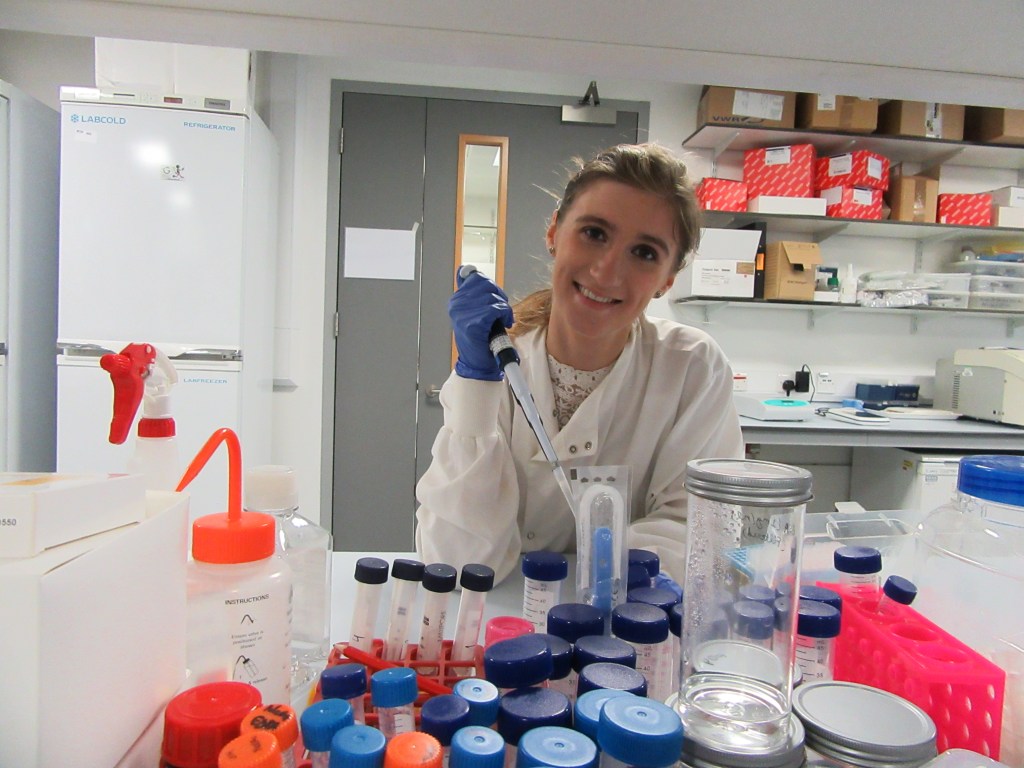
I’m Eleanor, a Trainee Clinical Scientist. I’m originally from a tiny town in Lancashire called Darwen but now I live and work in Chester for the NHS. I have a degree in Biological Sciences from the University of Birmingham and a PhD in Infection and Global Health, specialising in Veterinary Parasitology from the University of Liverpool. My PhD research was in vaccine design for a cow parasite. Now I am a Trainee Clinical Scientist on the NHS STP programme specialising in Microbiology.
What does your job role involve and what’s your day-to-day life at work like?
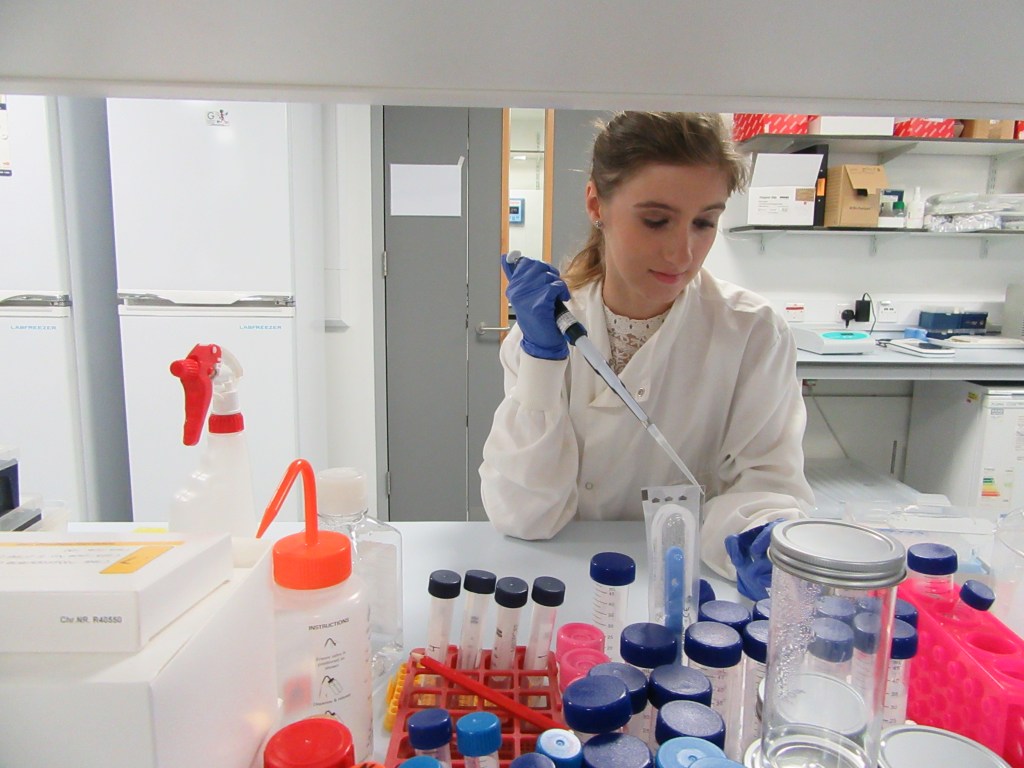
My days are very varied, at the moment I spend 3 days a week in the lab, going round the different benches and learning what happens when you send a patient sample in and what organisms are routinely tested for. I also get to see what methods are used for which organism and how results can be applied to different demographics. I have a study day 1 day a week. This year it is online due to covid and it involves 9-5 lectures provided by Queen Mary University of London (QMUL) and will lead to a masters qualification. I spend my remaining day at the Countess of Chester hospital with the Clinical Scientists and Consultants, learning how the results from the lab impact patient care. At the hospital I am also involved in phoning the wards and discussing patient treatment.
What pathway did you take to get into your job?
I didn’t always know I wanted a job in the NHS. After I finished my degree at the University of Birmingham followed by a PhD at Liverpool I originally wanted to go into academia but when I heard about the STP I thought that would be a better fit for me. I applied as a direct applicant and after logic tests, a written application and an interview I was lucky enough to be accepted.
What’s your favourite thing about your job and why?
I love how diverse it is and how every day is different. I am currently rotating around the different benches so I get to see the full range of tests and it keeps things interesting. I enjoy that I get to do a mix of clinical and lab-based work too as clinical work is a very different experience to what I am used to. I also enjoy that I can see how my work directly affects patients and can lead to improvements in their care and outcome.
What do you find most challenging about your job and why?
Time management is definitely tricky. Juggling a part-time masters 1 day a week with a full-time job which requires a portfolio of evidence of my work can be quite stressful. Making time to have a life around this can also be a struggle, especially when you have to do work in your own time after work and at weekends.
Do you ever doubt your abilities while at work? And if so, how do you overcome these situations/feelings?
I definitely do since I am new to the clinical setting and I have never worked in a diagnostic microbiology lab before, only an academic research lab. I try to remember that everyone on the STP is in the same boat and it is a learning experience for everyone, there are networks of trainees where we can all discuss how we are feeling and any techniques for learning and coping. The interview process was very rigorous and highly competitive and if we’ve all managed to get through that then we should be able to get through the STP.
What were you interested in growing up and do you think extracurricular activities and hobbies play an important role in encouraging more girls into STEM?
I was always interested in science as a child, particularly the natural world and animals. I was also a keen runner and ran for Hyndburn AC. This had a roughly 50:50 split of girls and boys and allowed me to mix with a variety of people. I think hobbies are very important to encourage curiosity and to allow people with similar interests to interact. If girls are introduced to STEM in a fun and friendly way then they may be more likely to pursue a STEM subject in the future.
While growing up, do you recall anyone that particularly motivated you to go into STEM?
Definitely my dad. He was very interested in science, and I still remember him taking me on walks to show the different bugs under rocks and he helped me set up my first microscope. We used to do mini-science experiments like creating volcanos from vinegar and baking soda which really turned me on to science. He also took me to science museums, like the Museum of Science Museum (MOSI) in Manchester. I’m not sure who enjoyed it more! He also came with me to see the Uncaged Monkeys which was a Science Communication based Stage show with Brian Cox and other communicators: Tim Minchin, Ben Goldacre, Robin Ince, Simon Singh and others.
I also had some amazing teachers at school that really encouraged me and also made science really interesting. I had a great biology teacher called Mrs Walsh that let us do fun experiments and always made lessons exciting and I think she is one of the reasons I went on to do Biology at university. I also had a Chemistry teacher called Mr Boyle who did the best Chemistry experiments, usually involving fire, which again made science really fun to learn.
Have you ever felt your gender has influenced the opportunities you’ve been offered and/or experienced so far?
I am probably quite different to most as I went to an all-girls school. One advantage of this is that there weren’t any defined gender stereotypes about different subjects, girls could do art, history, physics or maths and no subject was ever considered a ‘girly’ subject. I did biology at undergrad which was very female dominated, and both my PhD and job continue to be so. Therefore, in my experience, my gender doesn’t seem to have made a huge difference to opportunities I have been offered.
What do you think needs to happen to encourage more girls into STEM?
I think an awareness of the variety of STEM subjects would be helpful. For instance, physics isn’t just men doing equations, it can involve engineering and building or studying space and distant planets. Equally in the other sciences there are so many topics to cover that I was never even taught at school. I think teaching girls about female role models in the different sciences can could give them people to aspire to. Most scientists, historically, are men but there are plenty of female scientists that have had amazing ideas and lead to great discoveries and these should be mentioned and covered in schools and in clubs as well as the male scientists . I think encouraging some girl only science clubs could help some students. I found being able to engage with science with other girls where gender isn’t an issue and you can encourage each other very helpful. I think also encouraging girls to aim high within science is important, so they have to confidence to take part and explore lots of different ideas. In many cases when girls and women look for jobs they often won’t apply unless they have every skill asked for, whereas men will. I think it’s important to change that and the way girls see themselves with respect to jobs and science and find ways to give them more confidence.
What advice would you give to young girls who are interested in pursuing a STEM career?
I would say definitely go for it. Science is such a broad area that there is something for everyone, there are lab based jobs, site based jobs, office jobs and clinical jobs. Not to mention being out in the field. I have found a career in STEM so rewarding and I am very glad I made that decision.
Eleanor, thank you so much for sharing your journey from degree to PhD to STP – I absolutely take my hat off to you for working so hard to achieve so much already!
I think so many people will relate to feeling out of their depth because they haven’t been in a certain environment before. But like you said, everyone is in the same boat and if you can pass the scrutiny of the application process then you obviously deserve to be there. It’s also so important to remember how far you’ve come – that definitely helps when you feel overwhelmed and begin to doubt your abilities.
Making science interesting and fun is undoubtably the key to not only making it more accessible to younger people but also smashing the stereotypes behind typical “scientists”. I remember Chemistry experiments involving fire while I was at school as well and although they didn’t necessarily make me any better at Chemistry, they did make me enjoy the lessons more which was half the problem!
It is so crucial to make people, especially young girls, aware of the variety of STEM subjects – that was my main aim when starting Women in STEM Wednesdays. I had already gone through the whole university application process before even hearing that Medical Engineering was an option. Like you said, science etc isn’t just equations and theories – in fact it couldn’t be more opposite in most cases.
Encouraging girls to aim high is HUGE for confidence building – so many women have *that* voice inside their head telling them they can’t apply for something because they don’t fit the job description like a glove but their male counterparts wouldn’t think twice about applying. It all comes back to empowering women to ensure they know their self-worth!
Thank you again for taking part in WISW, Eleanor!
All my love, Meg x
p.s A massive take-home point I want people to have from Eleanor’s WISW episode is that there are no rules for what path/journey you have to take. Doing a PhD doesn’t mean you have to spend the rest of your life in academia if it isn’t the right environment for you. People are often quick to judge others for not directly following what their expectations say they should be doing. Whether you spend 1 month or 60 years in the sector you originally studied in, no one is in a position to tell you whether that is right or wrong for you. Change has a direct influence on growth and the beauty of STEM is the massive overlap of everything under the science, technology, engineering and mathematics umbrella! Do what is right for you, not for anyone else.

 Girls Who STEM