
hey, hello, hi!
This weeks #WISW/#WomeninSTEMWednesday is from PhD student Lucy!

Hi, I’m Lucy, I’m 24 years old and a third and final year PhD student at the University of Nottingham in the UK
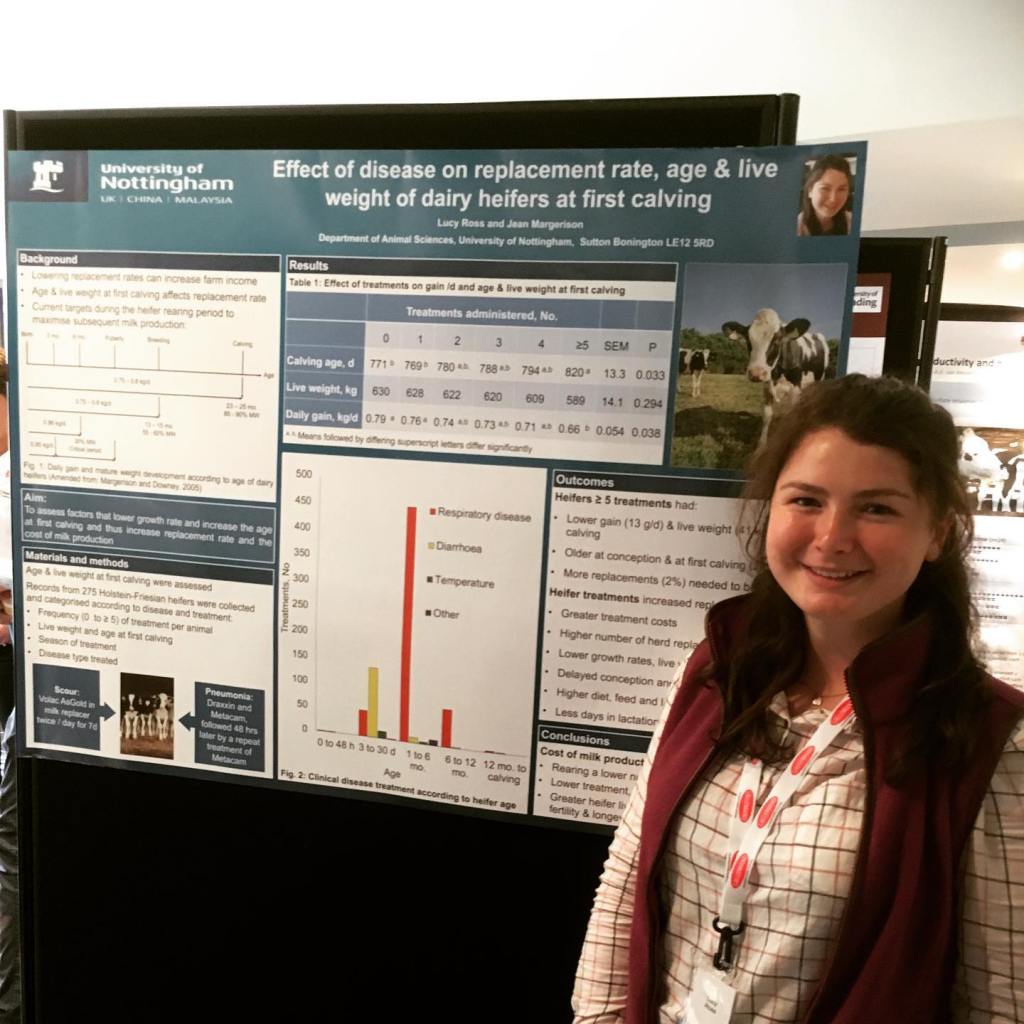
My research explores heifer rearing and whole-farm feed efficiency in UK dairy systems, in partnership with AHDB, which is the agriculture and horticulture development board. My research involves assessing the effect of factors in the rearing period of dairy heifer on her productivity and longevity in the milking herd and to improve the efficiency and profitability of the whole farm. My PhD aims to establish cost-effective approaches to rearing replacement heifers that optimise nutrition, health, and growth rate in relation to lifetime efficiency. This will contribute towards generating farm-based indicators to help improve whole-farm feed efficiency in dairy systems.
How did you get into your PhD?
I completed my undergraduate degree in BSc Animal Science (Hons) at Nottingham. When I saw the advert for the PhD, I had already confirmed my place to do an MSc in Veterinary Epidemiology at the Royal Veterinary College in London. I was revising my final exams in the library when the email came through. The PhD was co-led by my dissertation supervisor on a joint industry project that expanded my dissertation subject. It ticked a lot of boxes for me, so I decided to apply there and then! I never actually planned to do a PhD; it was just what sounded right to me at the time.
What made you choose a PhD over an industrial job?
I chose to stay on as a postgraduate student as I didn’t feel quite ready for a job as an undergraduate, and I also found I really enjoyed furthering my learning in a subject I’m passionate about. When I was in my final year, I thought a masters would suit me well as it would give me an extra year or so to decide what I wanted to do next whilst I improved my understanding of animal science. It just so happened that the right PhD came up at the right time which persuaded me to stay in education longer.
What does your day-to-day PhD life look like?
My day-to-day life varies depending what stage I am at, whether that’s literature review, data collection, on-farm, lab analysis, writing or attending industry events, conferences or workshops. I enjoy variety and prefer the days where I can do a little bit of everything. At the moment though I have finished my data collection and have started to write my thesis, so my days at home are very similar! I try to break my writing sessions up using the Pomodoro technique which I find really useful. I am also involved with a society (British Society of Animal Science) which adds a bit more variety to my working week by meeting different people and allowing some creativity with smaller tasks. Lastly, I have a horse which gets me going in the morning and keeps me active.
How is your PhD funded?
My PhD is slightly unique in that it is match funded with an industry partner, which I think is great as I get the best of both worlds. My stipend is paid by my university, but I am also able to attend events and conferences through my industry partner. During my time as a PhD student, I have worked as a unitemp demonstrating in undergraduate laboratory practicals as well as calf rearing on the dairy farm. I also write ‘animal byte’ articles for the BSAS which is a good little earner.
Have you ever doubted your abilities during your PhD? And if so, how do you overcome these situations/feelings?
On a daily basis! Overcoming my misconceptions of a PhD has been one of my biggest struggles. The academic world can be quite competitive, and I constantly feel I’ve got to do more to keep up. But I have learnt there is more to a PhD then publishing papers. It’s a fantastic opportunity for personal development too. My favourite thing about a PhD is that its an opportunity to become an expert in something you really care about. There is no specific curriculum or anybody who will teach you your PhD. You get there yourself and become a master of it.
What were you interested in growing up and do you think extracurricular activities and hobbies play an important role in encouraging more girls into STEM?
Absolutely! I was a very sporty child who enjoyed the outdoors and loved animals. I was very fortunate that I was able to be involved in sports teams, work at an equestrian yard and volunteer at a dog kennels. This is how I knew I wanted to work with animals, however at the time I thought the only role that could do that was a vet. I think engaging with like-minded people through a sports team, club, organisation, or an online group, gives you the space to express yourself and find out what you really enjoy. These groups who can help to support you with something you care about. It doesn’t matter what it is! Growing up I think it’s important to have these extracurricular connections outside of school and work life.
While growing up, do you recall anyone that particularly motivated you to go into STEM?
To be honest, I wasn’t aware of what STEM was all about when I was at school. I was set on applying to veterinary medicine as I thought that was the only role that worked with animals, I didn’t see it as science. However, my application was unsuccessful, and I chose to study animal science instead. It was only really when I was at university that I realised how big the world of science actually is. I never saw animal or agricultural science as a ‘real’ science, but I was proved very wrong! Science is more than glassware and lab coats and I wish I had someone growing up that I could talk to about this.
Have you ever felt your gender has influenced the opportunities you’ve been offered and/or experienced so far?
When I was deciding what I wanted to do after school I don’t think I was completely aware of the gender differences in opportunities. I went to an all-girls school and never questioned if I had the same opportunities. It was only when I was at university that I noticed the differences in gender ratios of different courses. When I was studying animal science the course was mainly girls, almost 80%. Whereas courses such as biotechnology or microbiology had a more balanced ratio. I also noticed a difference when I was working on the dairy farm completing my calf project. Our team leader would leave some jobs for the ‘boys’. I never understood this because I felt I was equally as strong, as fit, and as loud! Additionally, as a team we could achieve the same goal, whether that’s moving cattle or lifting farm equipment. I also found I would be asked to be the note-taker in group projects because as a girl it was assumed my handwriting would be neater, if only that was true!
What do you think needs to happen/what changes need to be made to get more girls into STEM subjects?
It has taken so long to break this stereotype of women in STEM subjects or even what a scientist looks like! But we need to continue to support the different opportunities available to girls to bridge the gender gap that still exists. Communicating and showcasing what women can do in STEM is so important so that girls can aspire to pursue their passion in STEM subjects. It is easy to tell girls that you can be whatever you want to be but the things you want to happen you have to make happen. You have to be a go-getter, especially as a girl when opportunities don’t always come up as easily for us. It takes courage to step up and make these chances happen for us, but it’s important we do, so that the girls coming behind us can see that girls can excel in STEM subjects. I think increasing the awareness of what girls can do after school would really help. We can support schools and youth organisations by giving presentations to classes and offering material or somebody to talk about what opportunities there are in STEM and how to get there.
What advice would you give to young girls who are interested in pursuing a STEM career or PhD?
My advice would be to stay curious, passionate and keep learning; you may not get to your end point straight away but focus on just the next step ahead. Don’t worry if things don’t go the way you thought or you wanted them to. It’s a skill to learn to adapt and to be versatile, and you may find something you didn’t know you enjoyed along the way! Girls can offer their own individuality, skills and perspective to STEM, which is what it’s all about. Nothing should stop you from doing what you want to do. The more passion and enjoyment you have for your subject the better you will do your job and that is what is most important!
Lucy, firstly thank you for blessing us with potentially the cutest calf picture ever! I just love animals, but especially baby ones. Your research sounds so interesting – I don’t know if it’s just me but I love hearing about other peoples research as it’s usually so far from my own.
You mentioning that you didn’t realise the extent of which science covers is so interesting. I bet there are so many people that don’t go into something that would be ideal for them because they just don’t know it exists. It highlights the importance of STEM talks at schools and universities to make people aware of what science actually means – like you said “it’s not just glassware and lab coats” and in fact although that’s probably the biggest stereotype involved with STEM, it only actually covers a very small part of it. It brings us back to the question of what does a scientist actually look like?
Ahhhh I bet the struggles you’ve mentioned are relatable for 99% of women in STEM! I could almost guarantee during my placement and undergraduate degree that I would be the one nominated to write notes?! And while I appreciate that the argument of most men is that they’re being chivalrous for lifting heavy things or doing the ‘tough’/’strenuous’ jobs, it is very hard to not find it semi-offensive when there’s nothing stopping us lifting as much as them!
You’ve really hit the nail on the head with encouraging young girls to be go-getters!! Boys/men (in general) have this amazing ability to take every opportunity offered to them without a second thought but it’s not always as easy for a girl – this is a large generalisation but girls do have to work harder to be offered the same opportunities as their counterparts! It is definitely down to our generation to pave the way and make STEM more accessible to future generations of girls. The more girls see women in STEM as normal the easier it will be for them to follow our footsteps. Even helping with lab demonstrations or open days as a woman in STEM could be enough to make even just one person more comfortable in venturing into a career in a male dominated sector!
I’ve absolutely loved hearing about your research and your thoughts on girls in STEM Lucy, thank you so much!
All my love, Meg x

 Girls Who STEM